

Happiness guaranteed or money back.
Subtotal$0.00
Taxes & ShippingCalculated at next step


How Gratsi Is Made
By Austin Holdsworth
September 15, 2026
People assume there's a formula somewhere. A binder, maybe. A locked recipe card that gets pulled out every harvest and followed to the letter.
There isn't one. Gratsi isn't a recipe. It's the art of balance, and balance has to be built fresh every single year.
Every bottle and every box starts long before anyone thinks about blending. It starts with grapes, and grapes are unpredictable. A hot summer changes everything. So does a wet spring, or a cool stretch in September that hangs on a week too long.
That's the real reason Gratsi doesn't rely on one patch of land to carry the whole wine. Our wine partners work vineyards across France, where they carefully select wine from their own sustainably farmed estates as well as from a network of longtime growers, cooperative wineries, and family-run domains, the kind of relationships built over years, not one good harvest. Close partnerships and careful oversight, from the vineyard all the way to the final blend, are what let those wine partners select the finest terroirs and wines to keep Gratsi's style and quality consistent, bottle after bottle, box after box.
France offers extraordinary diversity, and rather than leaning on a single region, our wine partners' sourcing extends across multiple Mediterranean terroirs.
Along the coast, sea breezes preserve freshness and contribute subtle saline notes to the grapes grown there. In the higher-altitude foothill country, cooler temperatures help preserve natural acidity in the wine. And further inland, mountain terroir brings structure and freshness that helps create balance in the blends.
Each of those origins plays an essential role in getting to balance. By sourcing from a range of terroirs with different climates and elevations, our wine partners can adapt to seasonal variation and soften the impact of localized weather events, all while keeping the style Gratsi drinkers expect. It's less "single origin," more "built for consistency, on purpose."


The word "cooperative" sounds bureaucratic, but the structure is worth understanding, because it's a big part of how a wine like Gratsi stays consistent year after year. In a French wine cooperative, individual growers pool their grapes together instead of each running their own small winery. The cooperative's winemaking team handles the pressing, fermenting, and blending, while the growers keep farming their own rows. Everyone gets a say, decisions get made together, and the smaller growers get access to equipment, technical support, and markets that would be out of reach on their own.
Practically, that means a family that's been farming the same few acres for generations doesn't have to also be an expert in fermentation science or export logistics. They grow good grapes. The winemaking team does the rest. It's a structure built for the long game, not a single great vintage.
That's also where the quality checks really start. The finished blend can only be as good as the grapes that go into it, which is why the relationships with growers matter as much as the winemaking itself. The growers Gratsi's wine partners choose to work with are ones who share the same environmental values and the same quality bar, not just whoever has grapes to sell that year. Respect for the vineyard, sustainable farming practices, and real partnerships with the people doing the growing are treated as the foundation everything else gets built on, not an afterthought.


Before any of the blending decisions get made, there's a short list of things every Gratsi wine is chasing: freshness, texture, bright fruit, and a softness that never tips into heavy. Because there's no added sugar to lean on, getting there depends entirely on the quality of the grapes, careful vineyard selection, and thoughtful blending. There's no shortcut sitting in a bag of sugar.
These are wines built to sit alongside simple, everyday Mediterranean-style cooking, food that doesn't need a wine to compete with it. Something that rounds out a meal instead of talking over it, and that still works fine poured on its own, without needing an occasion to justify it.

"Zero sugar, nothing unnecessary" isn't just a label claim, it's a description of what actually happens in the tank. Wine starts as grape juice, and grape juice is naturally full of sugar. Yeast eats that sugar and converts it into alcohol, and a fermentation that's allowed to run all the way through leaves nothing behind to hide. That's what makes a wine dry instead of sweet, and it's why the finished wine ends up with essentially no sugar left at all.
Ripe grapes matter so much going in for exactly this reason: they give the yeast enough natural sugar to finish the job on its own, no sugar added before fermentation, none added back in after. (See serving facts at gratsi.com/facts. For the deeper fermentation chemistry, we've also written a complete guide to sugar-free wine.)


This is where the winemaking team earns its keep. Blending isn't about masking a weak grape. It's about combining different strengths so the finished wine has more balance than any single variety could offer on its own. One grape might bring acidity and lift. Another brings deeper color and firmer structure. A third rounds out the fruit so nothing tastes thin or one-note. Winemakers usually ferment each variety separately first, then taste and test different proportions before committing to a final blend, because small shifts in ratio can change the whole wine's personality.
Rather than chasing an identical formula every vintage, the team chases an identical experience: the same freshness, the same easy texture, the same fruit that never tips into heavy. Getting there means tasting constantly. Debating. Adjusting a blend by a percent here, a percent there, sometimes late into the process, until it tastes like Gratsi is supposed to taste.
What matters isn't the exact percentage of Malbec or Grenache in any given year. What matters is the wine in the glass.

Each Gratsi wine leans on its own cast of grapes to get where it's going.
Gratsi Red Wine builds on Malbec and Cabernet for its backbone. Malbec brings dark fruit and soft, approachable tannins, the grape that made its name for being generous without being heavy. Cabernet adds structure and a firmer edge underneath it. Then Grenache and Syrah come in for warmth, red and dark fruit, and a silky texture that keeps the whole thing from feeling stiff. Part of that backbone also comes from partners across the border in Italy, where Nero d'Avola adds its own layer of dark fruit to the blend. The result is a red with real character that's still easy to pour on a Tuesday.
Gratsi White Wine leans on Sauvignon Blanc and Colombard for lift. Colombard is a high-acid, light-bodied grape known for lime, peach, and grapefruit notes, an aromatic, aperitif-style grape that's meant to be drunk young and fresh. Sauvignon Blanc adds its own citrus-driven brightness on top of that. Then Grenache Blanc and Vermentino round it out with texture and length. Vermentino in particular is known for a distinctive mineral, almost salty edge and a faint almond note on the finish, the kind of grape that bridges delicate and bold. Together, the blend comes out refreshing and generous at the same time, with real energy behind it.
Gratsi Rosé Wine pulls from Malbec, Pinot Noir, and Merlot for freshness and a bit of tension, then leans on Grenache, Cinsault, and Syrah for that sunnier, more generous personality. Cinsault does a lot of quiet work here. It's a soft, fruit-forward grape with low tannins and gentle notes of strawberry, peach, and pomegranate, and it's known for tempering stronger grapes around it so nothing overpowers the glass. That's the grape doing exactly what it's known for: keeping a rosé blend bright, food-friendly, and balanced instead of sharp or heavy.
Three different wines, three different approaches, one shared goal: something that works at the table, not just on paper.

It's worth saying plainly: none of this happens without people. Behind every Gratsi wine is a community of growers, winemakers, and partners who care about getting it right in the same basic way. Growers who farm the same rows year after year, through the years that are easy and the ones that aren't. Winemakers who show up to taste and argue about a blend until it's right, sometimes over a single percentage point. A team that treats a grower relationship the same way you'd treat a good supplier, worth protecting, worth checking in on, worth not burning for a short-term deal.
Nonna would call this common sense. You don't rush the people who grow your food, and you don't rush the people who make your wine either.


At the end of the day, Gratsi is meant to taste like where it comes from. The wines combine the saline freshness of the sea, the warmth of the garrigue, and the strength of the surrounding mountains. They're wines shaped by nature and guided by experience, crafted with care rather than assembled to spec. Above all, they're built to deliver the same pleasure, the same balance, and the same authenticity in the glass, no matter which bottle or box you happen to open.
None of this happens in a vacuum, and the results get judged the same way anyone judges wine: blind, by people who taste hundreds of bottles a year. Gratsi Red Wine has earned 91 points and Editor's Choice from Wine Enthusiast. Gratsi White Wine sits at 90 points and Best Buy. Gratsi Rosé Wine comes in at 89 points and Hidden Gem. Gratsi has also been named the No. 1 boxed wine in the country by USA TODAY's Readers' Choice Awards for the second year running, in 2025 and 2026.


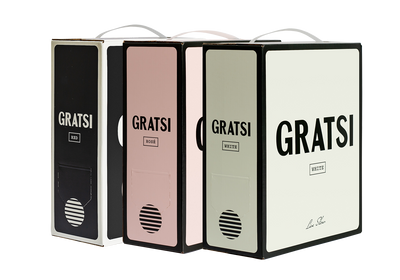
Once the blend is locked, it's on to the part you actually see and pour from. Gratsi's 3L box holds four bottles worth of wine, and the format isn't just about convenience. Inside that box sits a collapsible bag made from a material that doesn't let air pass through it. Every time wine gets poured out through the tap, the bag simply shrinks down around what's left, so there's no air pocket sitting on top of the wine the way there is the moment you pull a cork. That's the whole mechanism behind why it stays fresh for up to 30 days after opening, while an open bottle starts fading within a few days. We get into that oxygen problem in more detail in our guide to keeping wine fresh once it's open, and if you want the fuller box-versus-bottle breakdown, we put the two formats head to head here.
It's also a more efficient way to ship wine in the first place. Because the box is lighter and more compact than four individual glass bottles, it works out to about 85% less waste than shipping the same amount of wine in glass. We ran the actual numbers behind that in our look at boxed wine's carbon footprint.
Gratsi Sparkling White Wine and Gratsi Sparkling Rosé Wine are the two that come in a traditional 750ml bottle, both zero sugar, both built for more than just a toast.
Boxed wine still carries some old baggage from decades ago, but that reputation was always about what was in the box, not the box itself. We dig into where that stigma actually came from in this piece.
None of it is complicated on purpose. The winemaking is careful. The sourcing is deliberate. The packaging is just honest about what it is: four bottles in one box, nothing unnecessary, ready whenever dinner is.
That's the whole approach, really. Not a formula. Just ripe grapes grown across the Mediterranean, patient people, a fermentation that's allowed to finish what it started, and a blend that gets rebuilt from scratch every vintage so it can taste the same in the glass, no matter what the weather did that year.