

❤️ Love it, guaranteed
Subtotal$0.00
Taxes & ShippingCalculated at next step


Sustainable Wine
By Austin Holdsworth
September 02, 2026
Type "sustainable wine" into a search bar and most of what comes back is about the vineyard: organic farming, dry-farmed vines, biodynamic calendars, regenerative soil. All of that matters. None of it is where most of a bottle's carbon footprint actually comes from.
The research keeps landing on the same, less romantic culprit: the container. A widely cited review of the wine industry's environmental data found that packaging is routinely the single largest contributor to a wine's greenhouse gas emissions, often outweighing everything that happens in the vineyard and the winery combined, according to reporting from FoodPrint. Wine Enthusiast's own reporting on the topic put a number on it: traditional glass bottles account for roughly 29 percent of a wine's total carbon footprint on their own, with transportation adding another 13 percent, for a combined packaging-and-shipping share that approaches half of everything a bottle of wine emits before it reaches a glass.
That is the actual argument for boxed wine's environmental case, and it has almost nothing to do with what's inside the container. It has to do with what the container is made of, how much it weighs, and where it ends up. Here's what the research says, with sources, and what it means when you apply it to something concrete like a 3L box of wine instead of four separate bottles.
Glass starts as sand, soda ash, and limestone, and turning that mixture into a bottle means heating it to somewhere around 1,700°C, hot enough that the process alone makes glass manufacturing one of the more energy-intensive steps in the entire beverage supply chain. Globally, glass manufacturing is estimated to generate around 86 million metric tons of CO2 a year, per figures reported by FoodPrint. Producing new glass also isn't a one-to-one conversion: reporting from SevenFifty Daily notes it takes about 1.2 tons of raw material to make a single ton of finished glass, with roughly 10 percent lost in the melt.
Recycled content helps, but only partially closes the gap. Every 10 percent of recycled glass (called cullet) mixed into a furnace batch cuts energy use by about 3 percent and emissions by about 5 percent, according to the same reporting. That's a real improvement, but it means a furnace running on 100 percent virgin sand is still burning through more energy than most other packaging materials require, cullet or no cullet.
Compare that to what a bag-in-box format asks for. There's no furnace. The outer shell is corrugated cardboard, pressed and folded, not melted. The inner bladder is a lightweight, multi-layer plastic film. Neither step comes close to the heat or raw-material intensity of a glass furnace, and that gap shows up directly in the studies that have actually measured it.
The most rigorous side-by-side comparison available comes from a life cycle assessment conducted by UCLA's Institute of the Environment and Sustainability for Fetzer Vineyards, which measured the full environmental footprint of different wine packaging formats from raw material to disposal. The results: glass bottle packaging produces about 0.69 kg of CO2-equivalent emissions per liter of wine, while bag-in-box packaging produces about 0.172 kg CO2e per liter. That's more than four times the emissions for glass compared to the box, on a per-liter basis, once you count everything: material production, transport, and end of life. Total energy use followed the same pattern, at 7.89 megajoules per liter for glass versus 6.03 megajoules per liter for bag-in-box.
That result isn't an outlier. A separate 2010 environmental analysis run by the Scandinavian alcohol monopolies Systembolaget and Vinmonopolet, cited in Wikipedia's summary of box wine research, found that bag-in-box packaging carried between 12 and 29 percent of the carbon footprint of the equivalent bottled wine, and came out ahead of glass on essentially every other environmental measure the study tracked. Two independent research groups, on two continents, a decade apart, arrived at roughly the same conclusion: switching from glass to bag-in-box cuts a wine's packaging footprint to somewhere between a quarter and a tenth of what it was.
Weight is the other half of the story, and it compounds. Glass is heavy on its own, and a full bottle of wine makes that worse: a standard 750-milliliter bottle weighs around 2.65 pounds once filled, per figures reported by Wine Enthusiast. Every one of those pounds has to be shipped, refrigerated in some cases, and eventually hauled to a recycling center or a landfill, regardless of how much wine is actually inside.
A bag-in-box format sidesteps most of that dead weight, and the transportation math shows it. Using data from the Netherlands-based Topsector Logistiek's Transport Performance Database, industry analysis from The Wine Pack found that shipping wine in bag-in-box format cuts transport-related CO2 emissions by close to 40 percent compared to shipping the same volume in glass bottles. Part of that comes from weight, and part comes from shape: a standard truckload was calculated to carry around 11,930 liters of wine in glass bottles, versus roughly 25,000 liters in bag-in-box format, more than double the volume in the same trailer, because flat-packed boxes use the available cube of a truck far more efficiently than round bottles ever can.
That's not just a European finding. Reporting on research from Tablas Creek Winery found that distributing wine in bag-in-box format produced roughly 60 percent lower carbon emissions than distributing the same volume of bottled wine, a figure cited in BiboVino's sustainability research summary. Fewer trucks on the road to move the same amount of wine is not an abstraction. It's a direct, measurable consequence of shipping something lighter and flatter.
Here's where the story gets less flattering for glass, and it's worth sitting with honestly. Glass is technically infinitely recyclable, in the sense that it can theoretically be melted down and reformed without losing quality. But that only matters if it actually gets recycled, and in the U.S., most of it doesn't. The EPA's most recent detailed figures put the U.S. glass container recycling rate at 31.3 percent, meaning roughly 3.1 million tons of glass containers were recycled out of 9.8 million tons generated. Compare that to Europe, where the recycling rate for glass runs closer to 80 percent per SevenFifty Daily's reporting, and it's clear the gap isn't about the material. It's about American recycling infrastructure, which handles glass poorly: it's heavy to transport, it breaks and contaminates other recyclables in single-stream systems, and a lot of municipalities have simply stopped collecting it curbside.
Cardboard tells a different story. In that same EPA dataset, corrugated boxes were recycled at a 96.5 percent rate. More recent industry figures complicate that exact number: the American Forest & Paper Association has reported a 2022 corrugated recycling rate above 90 percent, while independent analysts who've audited the underlying trade and mill data put the real-world figure closer to two-thirds, arguing the industry's methodology overstates it. Even taking the more conservative of those estimates, cardboard is still recycled at roughly double the rate of glass in this country, and it does so through the same curbside bins most households already have, no special drop-off required.
This is where honesty matters more than marketing. The outer shell of a wine box, the corrugated cardboard, recycles the same way any shipping box does, through standard curbside programs available across most of the country. That part is straightforward and well supported by the recycling data above.
The bag inside is a different matter. It's built from multiple layers of thin plastic film, engineered specifically to keep oxygen out and wine fresh, and that same multi-layer construction is exactly what makes it hard to recycle through a standard municipal stream. Most curbside programs aren't equipped to sort or process flexible multi-layer plastic film, which is why it typically needs a specialty program, like a store drop-off or a mail-back service, rather than the blue bin. It's a legitimate limitation, and it's worth saying plainly rather than glossing over it: a wine box's cardboard shell is broadly recyclable in ways glass usually isn't, but that claim doesn't extend to the bladder inside, and it shouldn't.
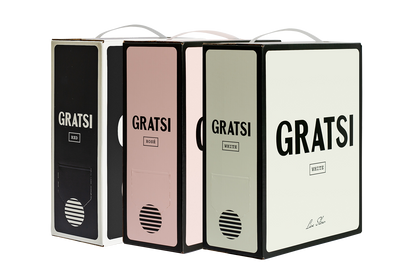
Applied to something concrete, the numbers above explain why Gratsi built its Red, White, and Rosé wines around the 3L box format rather than individual bottles. One box holds the equivalent of four standard bottles, about 20 five-ounce glasses, in a single container that's lighter, flatter, and requires no furnace to make. Gratsi Red Wine, Gratsi White Wine, and Gratsi Rosé Wine all ship this way, and the packaging generates roughly 85 percent less waste than the equivalent volume in glass, following the same logic behind the truck-loading and life cycle numbers cited above: less material in, less material to dispose of, fewer trucks needed to move the same amount of wine to the same number of tables. That math scales up fast at something like a wedding reception, where dozens of bottles' worth of glass gets replaced by a handful of boxes.
There's a freshness benefit tucked into that math too. A 3L box stays good for about 30 days after opening, compared to the day or two a glass bottle typically holds once uncorked, whether that means pouring a glass most nights or just measuring out a cup for a sauce instead of opening a whole separate bottle. That's less wine poured down the drain because it turned before anyone finished it, which is its own small but real reduction in waste, separate from the packaging itself.
Gratsi's outer box follows the cardboard side of this story: it's recyclable through standard curbside programs, the same category of material EPA and industry data both put well ahead of glass. Consistent with the honest caveat above, that claim covers the box, not the inner bag, which follows the same limitation as any bag-in-box wine on the market and isn't part of a standard curbside stream.
Not every Gratsi wine follows this format, and that's worth being upfront about too. Gratsi Sparkling White Wine comes in a traditional 750-milliliter glass bottle, because that's what the format currently requires to hold pressure and carbonation properly. The sustainability case in this article is specifically about the 3L box format, not a claim that applies across the whole lineup. For a closer look at how the two formats stack up beyond emissions, from cost per glass to shelf life, see Gratsi's boxed wine versus glass bottle comparison.
None of this requires believing packaging is the only thing that matters in wine, and it isn't a case against glass in every circumstance. It's a case for looking at where the actual emissions are, rather than where the marketing usually points. Multiple independent studies, run years apart by different institutions on different continents, keep finding the same thing: glass is heavy, it's expensive to make from an energy standpoint, and it doesn't get recycled at nearly the rate people assume. A flatter, lighter container made mostly of cardboard beats it on nearly every measured number, and the one place it falls short, the plastic bag inside, is worth naming rather than hiding. That's what a genuinely sustainable wine choice looks like: not a perfect one, but one where the tradeoffs are on the table.