

❤️ Love it, guaranteed
Subtotal$0.00
Taxes & ShippingCalculated at next step


Boxed Wine Has a Reputation It Never Earned
By Austin Holdsworth
September 04, 2026
Ask someone why they'd never buy wine from a box, and they'll rarely mention the wine itself. They'll mention the box. That's the whole story of boxed wine's reputation problem. It was never really about what's inside.
Bag-in-box wine was never supposed to be cheap. The format was invented in Australia in 1965, a genuinely clever bit of engineering built to store and pour wine well, not to cut corners on it.
Then the 1980s and '90s happened. A handful of mass-market producers flooded American grocery stores with low-quality wine packed into cardboard boxes, sold it by the gallon at rock-bottom prices, and a generation of drinkers learned to connect the format itself with the headache that followed.
The box was never the problem. The wine inside it was. That's a historical accident, not a permanent verdict on bag-in-box as a format. The stigma stuck to whoever used it first and loudest, not to any flaw in the technology.
Which raises a fair question: what happens when you put genuinely good wine in a box instead?
Researchers have looked into this exact question, and the findings line up. A 2024 study in the Australian Journal of Grape and Wine Research found that consumers are willing to pay less for the same wine when it's packaged in a bag-in-box instead of a glass bottle. Taste didn't explain the gap. The bias is social, not sensory.
A more recent study on ScienceDirect put a number on it: U.S. consumers apply discounts ranging from roughly 16% to 65% per 750mL for wine in alternative packaging compared to glass, based on the container alone. People read the box as a quality signal before they've tasted a drop.
That's a well-documented bias, and the useful part is that it corrects easily once you know it's there. An Italian survey found that 91% of wine drinkers initially said they'd only buy wine in glass bottles. Told that the quality would stay the same and the packaging would be more sustainable, 62% reconsidered on the spot. The preference isn't deep. It's just familiar.
The stigma around boxed wine is, more or less, an American one. In Scandinavia, France, and Germany, premium bag-in-box wine carries little to no stigma at all. Quality wine is routinely sold in the format, and nobody thinks twice about it.
Sweden is one of the highest per-capita consumers of boxed wine anywhere in the world. Its state-controlled retailer has promoted sustainable wine packaging for decades, and bag-in-box shows up at every price point as a result.
That matters, because the research also shows the stigma is socially learned, which means it's just as easily unlearned. When the people around you drink bag-in-box wine without a second thought, the price gap between box and bottle narrows. Acceptance spreads the same way skepticism did.
That shift is already underway here. Boxed wine shipments in the U.S. rose 17.3% in 2023, according to Alcohol and Tobacco Tax and Trade Bureau data, totaling more than 64 million liters. The cheap, generic end of the category is shrinking. The premium end is growing. America is catching up. It's just a few decades behind.
Gratsi is a big part of that shift firsthand. The brand grew from 2,000 cases sold in 2020 to 350,000 cases in 2025, and Nielsen has ranked it America's fastest-growing boxed wine brand, according to Inc.. Some of that is the wine. Some of it is that people are actually watching. Gratsi's Nonna Wisdom video series, which follows Italian grandmothers cooking family recipes in Sardinia, Puglia, and Calabria, regularly pulls in more views per episode than the brand has subscribers. People show up for the story and stay for the wine.


Most conversations about boxed wine lump everything together, as if a five-dollar jug and a 91-point blend belong in the same sentence. They don't. The gap between mass-market bag-in-box and premium bag-in-box is the gap between gas station coffee and a carefully roasted pour. Same vessel, completely different product.
Start with the mechanics. A vacuum-sealed inner bag collapses as wine is poured, so no air ever gets in to replace it. An opened box stays fresh for weeks instead of days. An opened bottle has about one to five days before oxidation starts to flatten it out. That's a real advantage, not a workaround, especially for anyone who wants a single glass on a Tuesday without a whole bottle staring back at them for the rest of the week. (Here's the full breakdown of exactly how long an opened box lasts, and why.)
Then there's what's actually inside. Premium bag-in-box producers are sourcing from real vineyards across Europe, and organic, artisanal, and estate-grown wines are increasingly showing up in the format. One well-regarded winery released a limited run of a premium rosé in bag-in-box recently and sold out in a matter of hours. Serious wine drinkers are already on board. They just haven't all said so out loud yet.
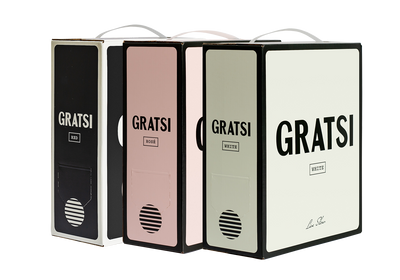
Gratsi's boxed wines are built to make that case on their own. No added sugar, sourced from France and Italy, and each one carries its own Wine Enthusiast score: Gratsi Red Wine at 91 points and Editor's Choice, Gratsi White Wine at 90 points and Best Buy, and Gratsi Rosé Wine at 89 points and Hidden Gem. Gratsi has also been named the No. 1 boxed wine in the country by USA TODAY's Readers' Choice Awards for the second year running, in 2025 and 2026.
From Wine Enthusiast. ©2025 Wine Enthusiast. All rights reserved. Used under license.
Most people think about wine's environmental footprint in terms of the vineyard. But according to a University of Helsinki study, packaging accounts for 57% of wine's total greenhouse gas emissions, and the glass bottle alone is responsible for up to 47% of that. The heaviest footprint in a glass of wine isn't in the grapes. It's in the container.
Switching to bag-in-box can cut wine's carbon footprint by up to 84% compared to glass. The materials are lighter, manufacturing takes less energy, and transport is dramatically more efficient. A 3-liter box takes six times fewer trucks to ship than the same volume in standard 750mL bottles.
The recycling math tells a similar story. Only around 31% of glass wine bottles in the U.S. actually get recycled. Boxed wine cartons, by contrast, are made from post-consumer recycled paperboard and generate far less landfill waste.
People are noticing. Roughly 75% of U.S. wine drinkers say they prefer sustainably produced wine, and about 60% of Millennials and Gen Z say they'll pay more for it. Choosing a format that produces 85% less packaging waste than glass is one of the simplest ways to act on that preference, no extra effort required. (We go deeper on the numbers in what boxed wine's carbon footprint actually looks like.)
The bad reputation attached to boxed wine was built by cheap producers in a specific era, and it was never really about the format. Bag-in-box keeps wine fresher after opening than a glass bottle does, sometimes by weeks. The environmental case is real and measurable. And the stigma is exactly what the research says it is: social, learned, and already fading in most of the world. (If you're still weighing the format on its full merits, not just its reputation, see our complete boxed wine vs. glass bottles comparison.)
None of this requires drinking more expensively or more carefully. Just better.
Pour a glass, skip the ceremony, and give a good bag-in-box an honest chance. The box was never the one that needed to prove anything. The wine inside always was, and more of it is starting to.