

❤️ Love it, guaranteed
Subtotal$0.00
Taxes & ShippingCalculated at next step


Fall Entertaining
By Austin Holdsworth
September 04, 2026
Fall hosting season doesn't announce itself with one big date anymore. It shows up as three or four separate gatherings between October and the holidays: a Friendsgiving, a football Sunday, a low-key dinner party that was supposed to be four people and became eight. A recent survey of 2,000 Americans found the average person now attends three different Thanksgiving-season gatherings, and 59% say they think of the whole stretch as a season rather than a single day. Almost a third of those gatherings are Friendsgiving-style, and hosts are already adjusting: 28% are asking guests to bring a dish, and 31% are keeping the guest list smaller on purpose.
None of that changes the one thing every host still has to solve before anyone walks in the door: how much wine to have on hand, and whether it's going to hold up across a night that runs longer than planned.
The standard planning rule for a multi-hour gathering is two to three glasses per guest, which works out to roughly half a bottle to a full bottle per person once you build in a buffer for the guest who pours generously or the one who orders a second round of appetizers instead of drinking less. At a standard five-ounce pour, one 750ml bottle holds about five glasses.
Run that math for eight guests at a fall dinner party and you're already close to a full case of individual bottles, each one needing to be opened, tracked, and finished or wasted. A 3-liter box of Gratsi sidesteps that entirely. One box equals four standard bottles, or about 20 five-ounce glasses, which covers eight guests at two and a half glasses each without a single cork pulled or a second bottle cracked open halfway through dinner. Run the actual cost-per-glass numbers and hosting a table of eight this way costs meaningfully less than doing it bottle by bottle, too.
The case for boxed wine at a dinner party isn't really about price, though that helps too. It's about what happens between the first pour and the last guest leaving.
A vacuum-sealed bag inside the box collapses as wine is poured, so there's no air rushing in to replace it the way there is with a bottle. That means a box you open on Thursday to test the wine still tastes right on Saturday when people actually arrive, and it stays that way for weeks, not days, so whatever's left over after the party doesn't need to be finished that same night out of obligation. One glass poured out for a guest who shows up an hour late is one glass, not a decision about whether to open a whole new bottle for one person.
It also means less to manage mid-party. Nobody's tracking which of six open bottles is closest to turning, and nobody's stuck doing math about whether to open bottle four with dessert still an hour away. One box on the counter, a stack of bàcaro glasses next to it, and the wine takes care of itself for as long as the night runs.
This isn't a niche workaround anymore. Premium boxed wine, priced at $28 and up, hit $1.6 billion in US sales in a recent year, up roughly 9% while bottled wine sales stayed flat. The stigma that used to follow the format is fading specifically because more people are hosting with it and having a normal night, not a compromised one. We've written about where that old reputation actually came from, and it has nothing to do with what a box does at an actual dinner table in 2026.
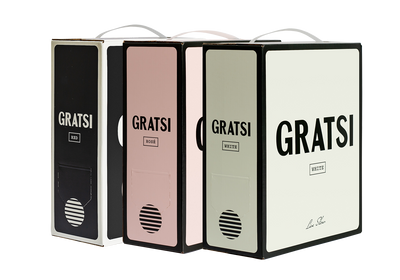
Gratsi's Red, White, and Rosé are built for exactly this kind of night. All three are made with no added sugar, sourced from France and Italy, vegan, and gluten-free, so nobody at the table has to ask what's in their glass before they say yes to a pour. Serve Gratsi Red Wine alongside anything coming out of a slow cooker or off a sheet pan of roasted vegetables, and keep Gratsi White Wine or Gratsi Rosé Wine in the fridge for guests who want something lighter. One of each covers a mixed crowd without needing to guess who drinks what.
A little bit of setup goes a long way toward making a box feel intentional rather than like the easy way out. Pour the box into a pitcher or carafe if you want it on the table rather than the counter. Keep a stack of glasses nearby so guests can help themselves after the first round, the same way they would with a pitcher of water. If the gathering spans an afternoon into evening, like a lot of fall football-and-food days do, the box's longer open life means you're not stuck deciding at 3 p.m. whether it's worth opening something new for the people staying through dinner.
For a bigger gathering, mix formats the way you would for any hosting occasion. Pour Gratsi Sparkling White Wine at the door for a toast-worthy start to the night, then let a box of Red or White carry the table through the meal. Neither format is the fallback option here. They're just doing different jobs, the way a good host uses the right glass for the right moment without overthinking it.
The quieter benefit of hosting with a box shows up the next morning. There's no recycling bin full of empty bottles to deal with, no half-finished bottle from the night before sitting open and turning on the counter while you clean up. What's left in the box is still good for weeks, which means the wine you bought for Saturday's dinner party can just as easily become Tuesday's glass with leftovers, instead of becoming something you feel obligated to finish or pour out.
That's really the whole case for boxed wine at a fall gathering: less to manage before the party, less to think about during it, and less waste after everyone's gone home. The wine still needs to taste good on its own, and it does. It just doesn't need the rest of the ceremony to get there.