

❤️ Love it, guaranteed
Subtotal$0.00
Taxes & ShippingCalculated at next step


Sugar In Wine
By Austin Holdsworth
September 02, 2026
You've seen both phrases on the same shelf, sometimes on the same bottle's website. "Sugar-free wine." "Low-sugar wine." "Dry wine." "Keto wine." They get used almost interchangeably, which is strange, because they don't mean the same thing at all.
Here's the short version before we get into the weeds: sugar, carbs, and calories in wine are three different measurements that happen to move together most of the time, which is exactly why people mix them up. A wine can be bone dry and still have real carbs. It can be low in carbs and still be higher in calories than a sweeter bottle sitting next to it. None of that is intuitive until you know where each number actually comes from.
We covered the basics of what "sugar-free" means for wine in The Complete Guide to Sugar-Free Wine. This piece goes further into the part that trips people up most: how sugar, carbs, and calories relate to each other, what "dry" technically means in grams, and how to read a residual sugar number like someone who's done it before.
Start with where each one comes from.
Residual sugar is the grape sugar left over after fermentation. Yeast eats sugar and produces alcohol and carbon dioxide as it goes. Winemakers stop that process, by choice or because the yeast runs out of food, at different points, and whatever sugar is left when fermentation ends is the residual sugar, measured in grams per liter (g/L). This is the number that determines how sweet a wine actually tastes.
Carbohydrates are the number on a serving facts label, and residual sugar is the largest piece of it, but not the only piece. Trace amounts of glycerol and unfermented complex sugars also count toward total carbs. That's why a wine's carb count and its residual sugar aren't always identical figures, even though they're closely related.
Calories are where most people guess wrong. It's easy to assume a sweeter wine is automatically higher in calories, but alcohol carries 7 calories per gram, almost twice what a gram of sugar carries at 4 calories per gram. In a lot of cases, alcohol content drives a wine's calorie count more than its sugar does. A high-alcohol dry red can land at more calories per glass than a lower-alcohol off-dry white, even though the red has less residual sugar. Sugar isn't the villain here and alcohol isn't either. They're just two separate inputs that land on the same label.
So when someone asks "is this a low-sugar wine," the honest answer requires knowing which of three things they actually care about: how sweet it tastes, how many carbs it has, or how many calories it has. Usually the answer to all three tracks together. Not always.
"Dry" gets used casually to mean "not sweet," which is close but not precise. In the wine world, dryness is defined by residual sugar, and there's an actual standard behind it.
The commonly cited international benchmark (used by the OIV, the intergovernmental body that sets wine standards, and reflected in EU labeling law) puts dry wine at up to 4 grams of residual sugar per liter, with an exception allowing up to 9 g/L if the wine's acidity is high enough to balance it out. High acidity makes sugar less perceptible on the palate, which is why a crisp, high-acid wine can carry a little more residual sugar and still taste completely dry.
There's a second, more casual number that shows up a lot: most tasters can't detect sweetness at all below roughly 1 g/L. That's the threshold people mean when they say "bone dry." So you end up with two true statements that look like they contradict each other: a wine can be legally and technically dry at 4 g/L, and still register as having a faint edge of sweetness compared to something at 0.5 g/L. Both are correct. "Dry" is a category, not a single number, and where a wine sits inside that category matters if you're being precise about it.
Rosé is where this trips people up most, since a lot of drinkers assume pink automatically means sweet. It doesn't. Color and sugar are two completely separate things, decided at two different points in the winemaking process.
This is the part worth bookmarking. Wine sweetness runs on a continuous scale, and these are the ranges most commonly used to break it into categories:
Bone dry (0–1 g/L). No detectable sweetness. Fruit reads as fruit flavor, not sugar.
Dry (1–4 g/L, up to 9 g/L with high acidity). The standard for most table wine. Little to no perceptible sweetness.
Off-dry, or medium-dry (4–12 g/L). A faint hint of sweetness, often balanced by acid so it doesn't read as "sweet" outright.
Medium sweet (12–45 g/L). Sweetness is clearly noticeable. Many popular white and rosé styles land here.
Sweet, or dessert (45 g/L and up). Distinctly sweet to syrupy. Late-harvest and fortified dessert wines can run well past 100 g/L.
A few things worth knowing about this scale. First, it's not officially standardized across every country, so you'll see slightly different cutoffs depending on the source. The ranges above reflect the numbers most commonly cited by wine regulatory bodies and educators, and they're close enough for practical use. Second, acid changes perception at every level of this scale, not just at the dry threshold. A high-acid wine at 8 g/L can taste crisper and drier than a low-acid wine at 5 g/L. Sweetness on the label and sweetness on the palate are related but not identical.
Here's the thing nobody tells you: there's no formal regulatory standard behind the phrase "sugar-free wine," the way there is for, say, a "sugar-free" claim on a cereal box. Wine sold in the US falls under the Alcohol and Tobacco Tax and Trade Bureau, not the FDA, and the specific labeling category "sugar-free" isn't clearly defined for wine the way it is for packaged food.
In practice, "sugar-free" almost always means "dry," or close to it. Because of how fermentation works, wine essentially never hits a literal 0.00 grams. Yeast strongly prefer glucose over fructose, so even a wine fermented all the way to dry can carry a trace of unfermented fructose, typically well under a gram per liter. That's not a flaw or a shortcut. It's just how fermentation chemistry behaves. So when you see "sugar-free" on a wine, read it as "genuinely dry, negligible residual sugar," not as a literal zero. It's the same kind of labeling confusion that shows up around sulfites, another wine claim that gets used far more loosely than the actual chemistry allows.
"Keto wine" gets searched a lot, and for good reason. A ketogenic diet runs on very tight carb limits, usually under 20 to 50 grams a day depending on the version, so every gram matters, and wine can be a meaningful chunk of a day's carb budget if you're not paying attention to style.
Here's the general pattern, independent of any one brand: dry wines, sitting low on the residual sugar scale above, tend to carry fewer carbs per serving than off-dry or sweet wines, simply because there's less leftover sugar contributing to the carb count. A dry red or white in the 1-to-2-gram carb range per serving fits into a tighter carb budget more easily than a medium-sweet white running 5, 8, or 10 grams a glass. That's a fact about how residual sugar and carb counts relate, not a claim that any dry wine is a "keto food." Wine isn't a keto product in the way a package of almonds can be. It's alcohol, and alcohol behaves differently in the body than a snack does regardless of its carb count. Diet compatibility is a personal call, and if you're tracking carbs closely, it's worth checking the actual serving facts on whatever you're pouring rather than trusting a marketing label.
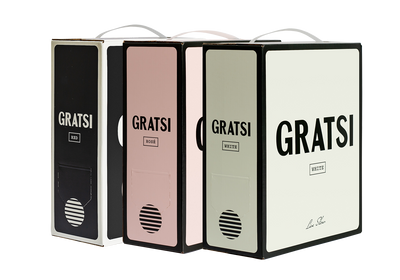
Gratsi Red Wine, Gratsi White Wine, and Gratsi Rosé Wine each carry 1 gram of carbohydrates per serving, plain fact, full details on each product page. We're not going to call it a keto wine. We'll just tell you the number and let you decide what it means for how you eat.
Most wine labels in the US don't list residual sugar in grams per liter the way a European label sometimes does. Here's what to look for instead.
Check for serving facts, which more producers are adding voluntarily even though it isn't universally required. If you see one, look at grams of carbohydrates per serving, not calories alone, since calories can be misleading given how much alcohol content contributes to that number. If there's no serving facts panel, the style category on the label (dry, off-dry, semi-sweet) is your best clue, cross-referenced against the scale above. And if you're comparing across a wine's whole line, styles typically don't vary as much as grape or blend does. A rosé, for instance, sits in a different spot on the sweetness scale than a red or white from the same producer more often than not, so don't assume one bottle's number applies across the board. Sugar isn't the only place labels get slippery, either. Organic and natural wine claims follow a completely different set of rules than most people assume.
Sugar, carbs, and calories are three different measurements that happen to correlate loosely, not one number wearing three names. Dry wine has a real definition, somewhere under 4 g/L of residual sugar with some flex for acidity, and "sugar-free" as a marketing term generally means the same thing: genuinely dry, not literally zero. If you're watching carbs for any reason, keto included, the residual sugar scale above is the actual tool, not the word on the front label.
If you want the fuller picture on how Gratsi wines fit into this, including full serving facts and ingredients for every wine, that's all posted on the Gratsi Red, White, and Rosé product pages. And if this is your first stop, The Complete Guide to Sugar-Free Wine covers the broader basics this piece builds on.