

Happiness guaranteed or money back.
Subtotal$0.00
Taxes & ShippingIncluded


Boxed Wine at Weddings
By Achilleas
May 05, 2026
There's a moment in every wedding plan where you start tallying the wine bill. Fifty guests. A hundred. Maybe more. Four hours of reception. Someone suggests boxed wine. Someone else raises an eyebrow.
Here's the honest version of that conversation. Boxed wine at a wedding used to feel like a compromise. It doesn't anymore. What's inside the box has caught up, and what couples expect from a wedding has shifted along with it. Smaller guest lists. Backyard and at-home receptions. Self-serve bars instead of full-service ones. More attention to what's in the glass, less to the theater around it.
This is the practical case for boxed wine at a wedding, written for couples still deciding whether it's right for theirs.

Nobody asks if the food at a wedding came from a box. They ask if it's good.
That's the right question for the wine too. The format is not the point. What's in the glass is. A dry, well-made wine in a 3L box pours the same as a dry, well-made wine from a 750ml bottle. If anything, a box on the counter is honest in a way bottles aren't. The couple didn't cut corners on the wine. They cut corners on packaging they didn't need. Most guests find that refreshing.
Weddings run on logistics. Wine is one of the trickier line items because it shows up everywhere. Cocktail hour, toasts, dinner, the late-night pours when the DJ is playing one more song. Every glass involves real physical work somewhere. Opening. Storing. Chilling. Carrying. Clearing. A 3L box simplifies almost all of it.
One box holds four bottles' worth, which is 20 glasses at a standard 5 oz pour. For a 100-guest, 4-hour wine-only reception, 92 bottles becomes 23 boxes. The venue doesn't need a case storage room. Nobody is counting bottles.
There's no corkscrew problem. A tap built into the bag-in-box means anyone can pour, including guests at a self-serve station. The catering team isn't opening a bottle every five minutes. If a box gets knocked off a table, you lose a few pours, not a shattered mess on the dance floor.
Ordering is easier too. A wedding wine order in bottles is a spreadsheet. A wedding wine order in boxes is a short count. Three reds, two whites, two rosés per 10 guests is a rough starting point for a 4-hour mixed reception. Most couples can hold the full order in their head.
Storage is simpler. Boxes stack flat. They don't need refrigeration until they're opened, and even after opening, they don't need to stay upright in a wine fridge. Refrigerator space, which is usually the bottleneck on a wedding day, stays free for food.
And the cost math works in favor of the couple. Boxed wine is priced per milliliter, same as bottled wine, but the premium you'd pay for individual bottling, labeling, corking, and shipping vanishes. On a 100-guest reception, the difference between a boxed-wine order and an equivalent bottled order often runs into the thousands.

The two numbers worth knowing: 30 days fresh after opening, and up to 85% less packaging waste than an equivalent amount of bottled wine.
On a wedding day, the freshness piece matters more than most couples expect. Wine in bottles has to be opened, poured, and mostly finished within a few hours or it goes to waste. Wine in boxes doesn't. If the crowd runs light on red and heavy on rosé, you're not left with nine half-full reds to dump. You're left with wine that's still good next week. That's a real dollar figure over the course of an event.
On the packaging side, a 100-guest wedding runs through roughly 90 glass bottles. A boxed-wine reception for the same crowd produces about 20 lightweight cardboard shells that stack flat and recycle curbside. For couples who care about what the day leaves behind, the number is hard to ignore.
This is the part that has actually changed. Ten years ago, "boxed wine" meant one thing. Today it covers a wide range, and the premium end is real table wine in a format designed for freshness.
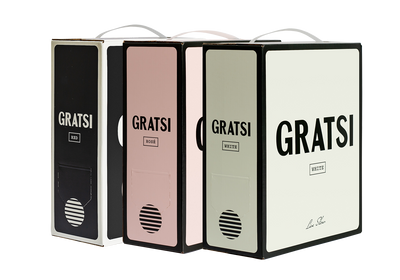
A handful of modern boxed wines are, in plain terms, quality wines built for a dinner table. Gratsi Red Wine, Gratsi White Wine, and Gratsi Rosé Wine are dry, fruit-forward Mediterranean-style wines with no added sugar, vegan and gluten-free. Gratsi was voted America's #1 Boxed Wine by USA Today and has earned some of the highest ratings Wine Enthusiast has given to boxed wine. It's a useful reference point for what premium boxed wine tastes like now, not the only option on the market.
The simple test: if you'd pour it on a Tuesday for dinner, it's good enough for a wedding.

Sparkling for the toast is almost always a bottle, which is completely fine. One 750ml bottle pours about five toast glasses, so divide your guest count by five and round up.
Gratsi Sparkling White Wine is a dry, clean option made in France with zero sugar and citrus and almond notes. Any dry sparkling the couple likes works. Toasts aren't the place to overthink it.
Boxed wine works best when it isn't hiding. A few practical notes.
Decant into carafes for seated dinner. A glass carafe in the middle of a table reads like a restaurant pour. Refill from the box out of sight.
Or lean in and let the box be the box. Modern boxed wines are designed to look good on a table. Set them out on a bar with a chalkboard sign, label the varietals clearly, and guests take the cue from there.
Chill the whites and rosés properly. Boxes actually chill faster than bottles because the bag makes direct contact with ice. A tub of ice water with the box fully submerged for 45 minutes does it.
Keep one backup stashed. A second box of the favored varietal in a cool spot is all most receptions need. If it doesn't open, it keeps. If it does, it's good for 30 days.
For the full layout and styling of a self-serve bar, we've put it all in one place: Wedding Drink Station Ideas: How to Set Up a Self-Serve Bar for Your Reception. The short version: don't treat the format like something to work around. Set it up on purpose. Guests follow the cue.
Boxed wine at a wedding is the practical move for more couples than it isn't. It saves money, reduces waste, simplifies logistics, and keeps wine fresh past the reception. It fits particularly well at smaller weddings, at-home receptions, and any wedding where the point of the day is the people at the table, not the packaging on the bar.
If you're planning quantities, our Wedding Alcohol Calculator does the full math by guest count, reception length, and bar style. And if you want to taste a premium boxed wine before the day, a Gratsi Wine Sampler Kit sends individual bottles of Gratsi Red Wine, Gratsi White Wine, Gratsi Rosé Wine, and Gratsi Sparkling White Wine to your door.
Nobody ever looked back and wished the dinner ended sooner.