

Happiness guaranteed or money back.
Subtotal$0.00
Taxes & ShippingCalculated at next step


Backyard Wedding Receptions
By Austin Holdsworth
May 05, 2026
A backyard reception sounds simple right up until the moment you start counting chairs. Then it becomes a different kind of project. Not a harder one. Just one that asks for a little more thinking up front, in exchange for a day that feels nothing like a venue wedding.
People keep choosing backyards for a reason. The place already means something. There are no rental contracts dictating when the bar closes. The dog is invited. And the cost of the building you're getting married in is zero, which leaves more money for the parts that actually show up in the photos.
Here's how to plan one without losing your weekends to spreadsheets.

The standard wedding venue charges for a slot. You arrive at four, you're out by eleven, and the next couple is loading in by morning. A backyard reception runs on a different clock. Setup can start on Thursday. Cleanup can wait until Sunday afternoon. Family who flew in can stay the night. Friends can stay later than the band.
The other thing a backyard does is strip out the parts of a wedding that nobody really wanted. The grand entrance. The mandatory "head table." The reception venue's preferred vendor list. None of it is required. You're hosting people in a place you love, which is what most weddings are pretending to be in the first place.
It also tends to cost less. Not always, but usually. The savings move to wherever you want them to go.
The yard sets a hard ceiling. Before you fall in love with a layout, walk the space and count.
A standard rule of thumb: 12 to 15 square feet per seated guest, including aisle space and table buffer. A 100-guest seated dinner needs roughly 1,200 to 1,500 square feet of usable flat ground. Add a dance floor (15 ft x 15 ft for 50 dancers). Add a bar zone. Add space for a band or DJ. Add room for the catering tent behind the scenes.
Most yards comfortably hold 60 to 80. Some hold 150. Almost none hold 200. Knowing the number first means the rest of the planning starts on solid ground.
Walk the property at the same time of day the reception will happen. Then walk it again two hours later. The light will be doing something different, and that matters.
Mark four zones in your head: ceremony (if you're doing it on-site), cocktails, dinner, dancing. Cocktails should sit between ceremony and dinner so guests have somewhere to drift while you flip the space. Dinner wants to be on the flattest, shadiest area you have. Dancing wants to be far enough from the neighbors that the sound doesn't become a problem at ten.
A few easy-to-miss details. Where does the sun set, and which way will guests be facing during toasts? (Nobody wants to squint through a speech.) Where are the bee nests, the gopher holes, the soft patches that turned to mud last spring? Where's the closest hose bib, in case something needs rinsing? Where's the ugly view that needs hiding, and what would hide it? (A hedge of potted olive trees in pots. A linen drape on a frame. Done.)
Most outdoor weddings look best in the hour before sunset. That hour gets called "golden hour" for a reason. You want the ceremony or the toasts inside it.
Find the sunset time for your date. Work backwards. Toasts and dinner courses should land in that window. Cocktail hour starts roughly 90 minutes earlier. Ceremony starts another 30 to 45 minutes before that.
Once the sun is fully down, the energy shifts to the dance floor and the bar. Plan the band's first set to start within 15 minutes of sunset, while people are still warm from dinner.

A tent is not optional, even if the forecast is clear. It's shade in the afternoon, shelter at dusk, and the difference between a manageable rain plan and a disaster. Book the tent first. Most companies want six months of lead time during peak season.
What the rental order usually includes: tent, sidewalls (have them on hand even if you don't put them up), tables, chairs, linens, glassware, plates, flatware, a dance floor (your lawn cannot be one), and lighting. Ask the rental company three things: when they deliver, when they pick up, and where the empty crates live in between. Empty crates are surprisingly large.
A small tip that has saved a lot of receptions: get 10% more chairs than your guest count. Some break, some get lost in the lawn, and someone's going to want a quiet seat in the corner.
You have three real options.
Full catering is the easiest to run and the most expensive. Worth it if your yard is small and your guest count is large.
Hybrid catering is the most common backyard choice. You hire a caterer for the main meal and the kitchen logistics. You handle the apps, the late-night snack, and the dessert table yourself. This lets you fold in the dishes that mean something to your family without anyone being on grandma duty for six hours.
DIY catering works, but only at smaller counts (under 50) and only with a friend or family member running the kitchen who is not a guest. The math breaks down past that.
A few things to know either way. Plated dinners look elegant and need staff. Family-style platters are warmer, more Mediterranean, and ask for less service. Buffets and stations move the fastest and need the least staff. Pick the one that matches the number of helpers you actually have.
Catering kitchens need power, water, and a place to plate. Most caterers will tell you what they need before they arrive. Listen carefully.
If you do one thing right, do this one. Backyard receptions live or die by what happens at dusk.
The basic kit: warm string lights overhead (Edison-style, not blue-toned), uplights at the perimeter to wash the trees, candles or hurricane lanterns on every table. Avoid floodlights. Avoid cool white. Anything that reads as "stadium light" will flatten the whole evening.
If you're hanging lights yourself, plan two layers: one functional layer that lights the path between zones (so nobody trips on a tree root walking to the bathroom), and one ambient layer over the dinner and dance areas. Test the rig at the same time of night as the reception, two days before.
Hope is not a plan. Two backups, written on paper:
Rain plan: tent sidewalls go up, ceremony moves under cover, lawn games come inside, and the photographer is briefed in the morning so nobody is improvising at three. If the forecast crosses 60% probability the day before, commit to the rain plan and move on.
Cold snap or heat plan: heaters or fans on standby (rent them when you book the tent, not the morning of). A basket of pashminas at the cocktail entrance for cold nights. A water station with citrus and ice for hot ones.
Backyards are forgiving as long as you have a plan. The day everyone remembers is the one where rain rolled through during the toast and nobody flinched.
The pieces nobody talks about until something fails.
Power. A backyard typically has two or three working circuits. A reception needs more. Talk to a rental company about a small generator, or a friend in the trades about running an extra line for the day. Map out which circuit runs the band, which runs the bar, and which runs the kitchen. Don't put them all on one.
Water. The caterer needs it, the bar needs it, the bathrooms need it. If your house can't carry the load, ask the rental company about a portable handwashing station near the catering tent.
Bathrooms. One household toilet for 100 guests is not enough. Rent a single upgraded portable unit (the trailer kind, not the construction kind) and place it discreetly. Add signage so guests can find it without walking through the house.
Parking. If you're spilling onto the street, talk to your neighbors a month out. A friendly heads-up goes a long way. If the yard has space, designate a parking attendant. (One willing teenager with a flashlight.)

The backyard reception bar is almost always self-serve, which is a feature, not a compromise. A self-serve setup means no bartender bottleneck, no pour limits, and no awkward tipping conversation. It also means the bar setup needs to do its own talking.
The simple version: one wine station (red, white, rosé), one beer cooler, one signature cocktail option in a batched dispenser, and a non-alcoholic corner with sparkling water and citrus. That's enough for almost any reception.
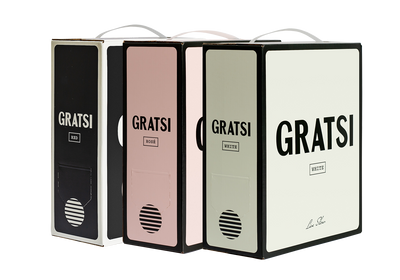
For the wine, boxed wine is built for this exact use case. One 3L box pours 20 glasses, taps without a corkscrew, doesn't shatter if it's knocked over, and stays fresh for 30 days if you have leftovers. We made the full case for it in Why Boxed Wine Is a Great Option for Your Wedding.
For quantities, the math depends on your guest count, reception length, and whether you're going wine-only or full bar. Our Wedding Alcohol Calculator does the per-guest count for you. A rough starting point: plan one drink per guest per hour, biased toward wine for a seated dinner crowd.
Sparkling for the toast is one bottle for every five guests. Gratsi Sparkling White Wine is a dry, clean option made in France with zero sugar if you want something simple. Any dry sparkling works.
The single biggest difference between a backyard reception that runs smoothly and one that doesn't is whether someone other than the couple is in charge.
You need a ground team. Not a wedding planner necessarily (though hiring a day-of coordinator is the best money you'll spend if it fits the budget). At minimum: one person who runs the timeline, one person who handles vendor questions, one person who handles family questions, and one person whose only job is to make sure the couple eats. Brief them the night before. Give them a printed timeline. Give them each other's numbers.
The ground team is not the wedding party. The wedding party is there to be in the photos and stand at the front. Asking your maid of honor to also direct the caterer is how a friendship gets quietly damaged.
Backyards do not need to be transformed. They need to be edited. The most beautiful at-home receptions don't try to disguise the place. They highlight what's already there. The old fig tree gets uplit. The garden path becomes the aisle. The hand-thrown ceramic plates from your honeymoon to Puglia come out of the cabinet for the dinner table.
A loose Mediterranean influence travels well in this format. Linen runners. Olive branches in low jars instead of tall florals. Lemons and rosemary on the platters. Long tables instead of round eight-tops. The whole vocabulary of a long, slow dinner outdoors is the same vocabulary a backyard reception is reaching for. We've written about that pace and that aesthetic in The Art of Slow Living: Lessons from the Mediterranean Lifestyle and Adding Mediterranean Into Your Home, if it's the mood you're after.
A backyard reception is more work than a venue wedding. It is also the version where the day actually feels like the couple. The planning is real but finite. Start with the yard, build the timeline backwards from the light, book the tent early, plan for rain, lean on a few good helpers, and keep the bar simple.
Then enjoy the part that no venue can give you. The lights still on at midnight. The slow walk back to the kitchen. The leftovers in the fridge in the morning.
If you want a head start on the drinks math, our Wedding Alcohol Calculator sizes the order in about a minute. And if you want to taste a few wines before deciding what goes on the bar, a Gratsi Wine Sampler Kit sends individual bottles of Gratsi Red Wine, Gratsi White Wine, Gratsi Rosé Wine, and Gratsi Sparkling White Wine to your door.